Gov Eno’s Audacious Imprints of Development in Oruk Anam
By Mercy Udoh
There are moments in the history of a people when development ceases to be a campaign promise and becomes a lived reality. Such moments are not defined by political rhetoric or grand declarations, but by tangible improvements in the lives of ordinary citizens.
They are reflected in the roads that shorten journeys, the schools that inspire confidence, the hospitals that restore hope, and the homes that provide dignity. Today, across Oruk Anam Local Government Area, such a story is unfolding, one project, one community, and one fulfilled promise at a time.
From Ikot Ekaideh to Ikot Okoro, from Ikot Ibritam to Ediene Atai, the signs of transformation are becoming increasingly evident. Communities that once grappled with poor access roads are witnessing improved connectivity.
Public institutions that struggled for attention are receiving strategic investments. Families burdened by difficult living conditions are benefiting from targeted interventions designed to improve their quality of life.
The cumulative effect is a growing sense that Oruk Anam is not merely witnessing isolated projects but experiencing a deliberate and coordinated effort to reposition the local government for sustainable growth and shared prosperity.
At the centre of this transformation is Governor Pastor Umo Eno’s development philosophy, one anchored on the conviction that governance must be people-centred and that development must reach the grassroots.
Rather than concentrating investments in a few urban centres, his administration has pursued an inclusive approach that ensures communities across the state share in the dividends of governance. In Oruk Anam, this commitment has translated into strategic interventions spanning infrastructure, education, healthcare, housing, youth development and human capital advancement.
Perhaps nowhere is this transformation more visible than in the area of road infrastructure. In a predominantly agrarian local government where economic activities depend heavily on movement and accessibility, roads represent much more than physical structures. They are lifelines that connect farmers to markets, traders to customers, students to schools and residents to opportunities.
The completed and commissioned 23-kilometre Ikot Ekaideh–Ikot Okoro–Ikot Ibritam Road, together with its two bridges, stands as one of the most significant infrastructure projects undertaken in the area in recent years. Beyond the asphalt and concrete lies a project that has transformed the experience of travel for thousands of residents. What was once a difficult and time-consuming journey has become significantly easier, opening up communities and strengthening economic interactions among people whose livelihoods depend on connectivity.
The equally important 4.6-kilometre Ntak Ibesit–Ekparakwa Road has further improved accessibility and enhanced mobility within the area. For residents who previously contended with difficult travel conditions, the road has brought relief while contributing to increased economic activities and improved transportation efficiency.
Yet, the story of infrastructure development in Oruk Anam is not confined to completed projects alone. Work continues on the construction of the 18.95-kilometre Ikot Ibritam–Inen Ekefe–Ikot Akpan Afaha Road with two bridges, a project expected to significantly improve access to several communities upon completion. Construction is also progressing on the 12.5-kilometre Ikot Ebak–Ediene Atai–Ibesit Road, opening new pathways for movement and commerce.
Additional interventions, including the 2.5-kilometre Ikot Ibritam–Ikot Ekpuk Road with a bridge and the strategic road corridor connecting Abak and Etim Ekpo through Ndot Ikot Edah, underscore a clear understanding that economic development often begins with physical connectivity. Indeed, every kilometre paved is more than a completed project; it is a promise fulfilled, an opportunity created and a community connected to the broader aspirations of development.
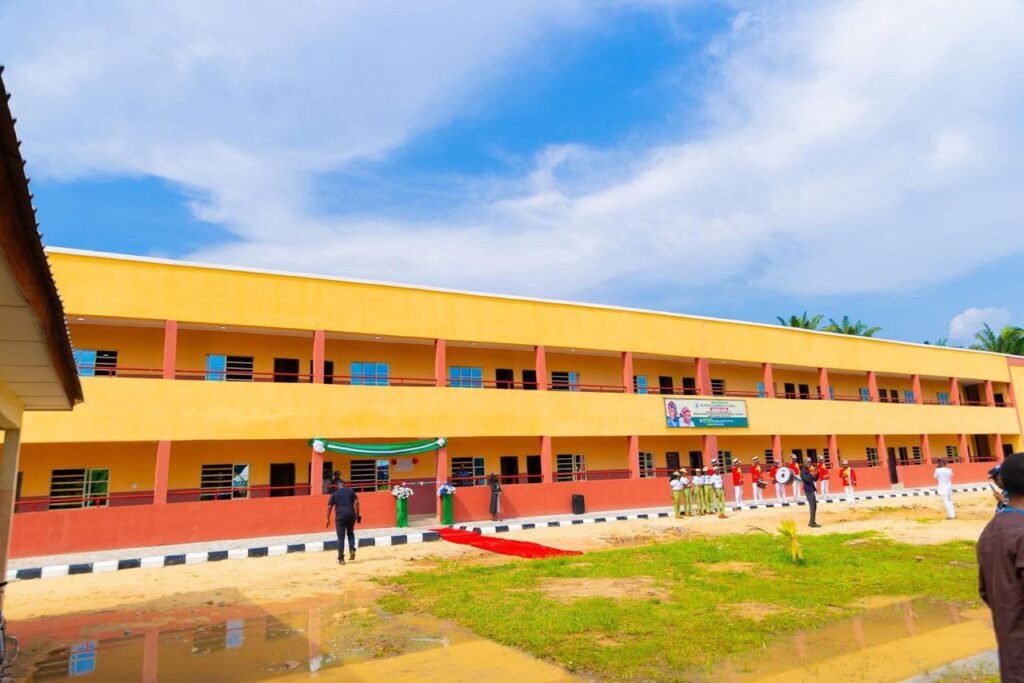
The transformation underway extends beyond roads and bridges. In the education sector, the story of the Model Primary School, Ikot Ibritam, has become one of the most compelling examples of how strategic investment can restore confidence in public education.
Once recording fewer than sixty pupils, the school now boasts an enrolment exceeding five hundred. Such remarkable growth is not merely a statistical achievement; it is evidence of renewed trust by parents who increasingly believe that public schools can once again provide quality education for their children.
Healthcare is experiencing a similar renaissance. The ongoing construction of the Model Health Centre at Ikot Osute reflects the administration’s determination to strengthen primary healthcare delivery and ensure that quality medical services remain accessible to rural communities. At the same time, the ongoing upgrade of facilities at the General Hospital, Ikot Okoro, is expected to enhance service delivery and improve the institution’s capacity to meet the healthcare needs of residents.
For many communities, these healthcare interventions represent more than physical structures. They represent reassurance. Reassurance that medical attention will be available closer to home. Reassurance that mothers and children will have improved access to healthcare services. Reassurance that healthcare delivery will meet standards capable of improving the overall well-being of the people.
Perhaps the most touching dimension of Governor Umo Eno’s interventions in Oruk Anam is the ARISE Compassionate Homes initiative. While roads and public infrastructure often dominate headlines, the provision of decent housing to vulnerable families speaks directly to the human side of governance. Across the local government area, more than ten compassionate homes have already been completed, while several others remain under construction. Behind each completed home lies a powerful story of hope restored, dignity preserved and lives transformed.
Beyond physical infrastructure, Governor Umo Eno’s impact on Oruk Anam is also reflected in the calibre of sons and daughters of the area who have been elevated to strategic positions within the state governmen
While roads, schools and healthcare facilities provide visible evidence of development, the inclusion of competent Oruk Anam professionals in key decision-making roles represents an equally important investment in the future of the local government. Through these appointments, local talents are contributing to governance, policy formulation and public service delivery while strengthening Oruk Anam’s voice within the broader governance architecture of Akwa Ibom State.
Other interventions, including the construction of the Chairman’s Lodge and the proposed Youth-Friendly Centre, reflect a broader vision that seeks not only to strengthen institutions but also to prepare young people for future opportunities. Such investments demonstrate an understanding that sustainable development must address present challenges while creating pathways for future generations to thrive.
Taken together, these projects tell a compelling story about the direction in which Oruk Anam is headed. They reveal a pattern of development that prioritises connectivity, education, healthcare, social welfare and human capital advancement. More importantly, they demonstrate a commitment to ensuring that development is measured not merely by the number of projects executed but by the extent to which those projects improve the lives of the people they are intended to serve.
The making of a new Oruk Anam is therefore not a distant aspiration waiting to be realised. It is a reality already taking shape across communities and households. It can be seen in the roads that connect previously isolated settlements, in the classrooms filled with eager learners, in the healthcare facilities rising across the landscape, in the compassionate homes sheltering vulnerable families and in the opportunities being created for future generations.
As these interventions continue to unfold, they point to a simple but profound reality: development is most meaningful when it reaches the grassroots, addresses real needs and leaves communities better than it found them.
That reality is increasingly evident across Oruk Anam, where Governor Umo Eno’s audacious imprint of development is not merely visible in concrete and steel, but in the renewed hope, growing confidence and brighter future of the people.